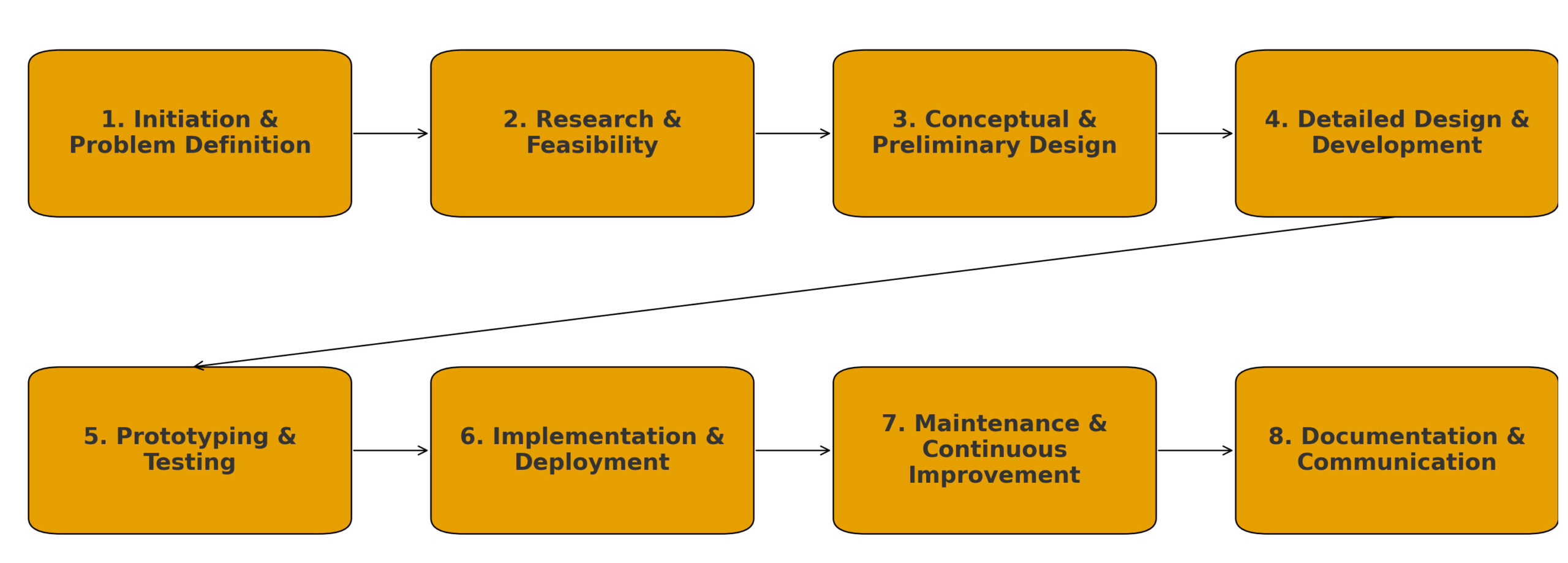
Whether it’s designing infrastructure, building software, or developing new products, engineering work follows a structured process known as the project lifecycle. While details vary across disciplines, most engineering projects move through a common set of stages that guide work from initial concept to final delivery.
1. Project Initiation and Problem Definition
- Gather requirements from clients, stakeholders, or internal teams.
- Define project goals such as performance, safety, cost, and compliance.
- Document constraints like budget, regulations, or environmental impact.
Example: A mechanical engineering project might involve designing a new piece of equipment that improves efficiency without exceeding cost limits.
2. Research and Feasibility Study
- Review prior solutions or industry benchmarks.
- Conduct feasibility analyses to weigh costs, risks, and timelines.
- Run initial calculations or simulations to validate options.
This step prevents wasted effort by ensuring the project has a realistic path forward.
3. Conceptual and Preliminary Design
- Develop high-level sketches, CAD models, or system diagrams.
- Compare multiple design concepts against requirements.
- Conduct peer reviews to refine and down-select ideas.
4. Detailed Design and Development
- Create detailed drawings, schematics, or source code.
- Run advanced analyses (e.g., FEA, system testing).
- Prepare specifications, bills of materials, and process documentation.
5. Prototyping and Testing
- Build and assemble test versions of the product or system.
- Run experiments and collect performance data.
- Identify flaws, make improvements, and repeat tests.
Testing ensures the design meets safety, compliance, and reliability standards.
6. Implementation and Deployment
- Coordinate with manufacturing, construction, or deployment teams.
- Manage schedules, resources, and supply chains.
- Oversee quality control to confirm specifications are met.
7. Maintenance and Continuous Improvement
- Monitor system performance over time.
- Troubleshoot problems that emerge in the field.
- Incorporate lessons learned into upgrades or future projects.
8. Documentation and Communication
- Write reports, technical documentation, and manuals.
- Keep detailed records for compliance and future reference.
- Present updates and results to both technical and non-technical audiences.
Why the Project Lifecycle Matters
- Structure: A clear roadmap for managing complex technical work.
- Collaboration: A common framework for cross-disciplinary teams.
- Quality assurance: Confidence that outcomes meet requirements and standards.
DFMEA vs. PFMEA: Differences, Examples and When to Use Each
Top Lead Generation Companies for Engineering Businesses (2026)
Engineering Design Essentials: From Power Systems to Prototyping
The Complexity of Modern Engineering Design Designing engineering systems is as much about avoiding mistakes as it is about innovation. Every decision — whether it’s choosing a material, configuring a control system, or running a thermal simulation — has consequences...
How to Build a Future-Proof Engineering Career: Skills, Salaries, Licensing, ROI, and Career Transitions
Why Career Strategy Matters for Engineers Engineering has always been a field where technical expertise meets real-world impact. Yet the modern engineering workforce faces challenges that extend beyond design equations and CAD models. Job security, career advancement,...
Finding Balance: How Engineers Can Decompress After Work
Engineering is a profession that demands precision, focus, and long hours of problem-solving. Whether it’s designing infrastructure, writing code, or managing complex projects, engineers often carry the stress of deadlines and responsibility well beyond office hours....